Learn the Smart Way to Study
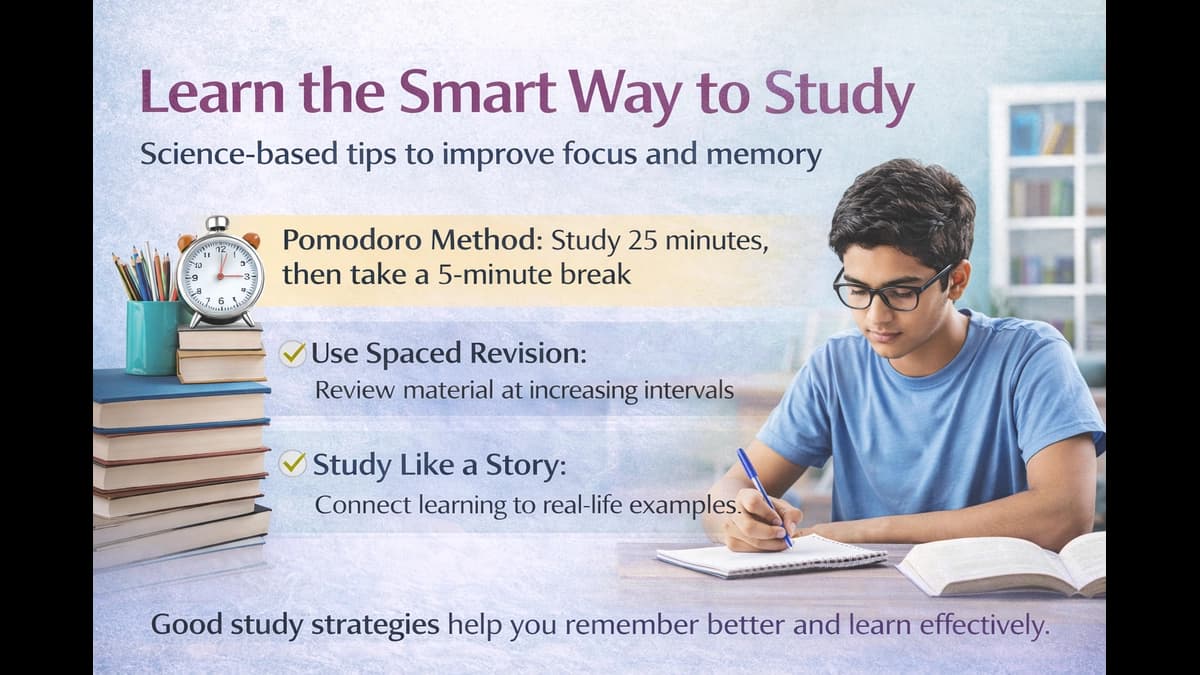
Many children spend long hours studying but still forget what they have read. Some even feel sleepy as soon as they open their books. This is not always due to laziness—it is often the result of poor study strategies. According to education experts, children need to be guided to study in ways that match how the brain actually works.
Research shows that academic success depends more on how a student studies rather than how long they study. That is why smart study methods, supported by psychology and science, are more effective than simply increasing study time.
Try the Pomodoro Method
The human brain can focus on only one task at a time. When children try to study while watching TV, listening to music, or checking messages, their concentration suffers.
Experts recommend studying for 25 minutes with full focus, followed by a 5-minute break. This is known as the Pomodoro Method. It helps prevent mental fatigue and improves memory.
After completing a study session, students should close their books and test themselves by recalling what they have learned. They should reopen the book only to check their answers. This habit strengthens understanding.
Another effective method is spaced revision—reviewing the same lesson after two days, then a week later, and again after a month. This technique helps store information in long-term memory.
Change Study Locations
Studying in different places can improve focus and recall. When students read in varied environments, their brains stay more alert and engaged.
For example, they can study sometimes in their room, sometimes on a balcony, or in another quiet corner. This simple change can boost concentration and understanding.
Psychologists also say that handwritten notes are more effective than typing. Instead of making only digital notes, students should write short points by hand. This improves learning speed and memory retention.
Study Like You’re Reading a Story
The brain remembers stories more easily than isolated facts. That is why people often remember movie plots for years but forget formulas quickly.
Students should try to learn history as stories and connect science concepts to real-life examples. When lessons are linked to emotions and experiences, memory becomes stronger and learning feels more natural.


